What's on your plate?
A Guide to Tracking Your Consumption

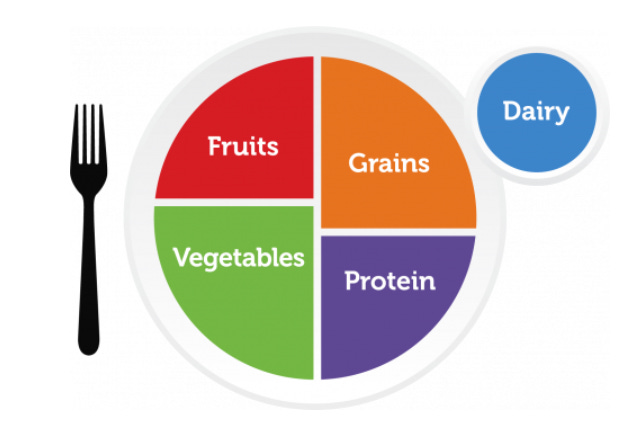
Remember filling out the USDA MyPlate in high school health class? We learned about the food pyramid and key food groups - fruits and veggies, grains, protein, and dairy. Then they gave us guidelines for making a balanced plate, like ideal proportions across food groups and limiting saturated fats. And then, we were asked to draw our own plate using what we learned. It was meant to remind us to eat a variety of foods in a balanced way.
What if you were asked to draw a plate representing your overall consumption? A plate with everything you read, listen to, buy, watch, do and eat. What would you learn about your “diet” and how it makes you feel? If we are what we eat, who does your overall consumption make you?
I’ve been hearing from a lot of friends recently that it feels like our brains are maxed out. We’re fatigued from algorithmic overstimulation and overwhelmed by content shoved in our faces. We’re overconsuming.
It makes you think - What’s on your plate? What are the key consumption groups? Is your plate balanced?
To answer these questions, we would first have to log everything we engage with and sort it into categories of consumption. There are so many ways to do this. Sometimes I use one grouping and the next time, another.
Here are a couple that come to mind:
food, housing, clothing, transportation, health, beauty, education, entertainment, and activities.
reading, listening, watching, eating, buying, doing, thinking
social, health, intellectual, materialistic
Next, we’d have to figure out what we’re interested in uncovering and try to find patterns in the data. Fun!!! (I was a math major, can you tell).
I’m curious to understand how much of my behavior is dictated by algorithms and my digital presence. You might be curious about your spending habits. If so, ask yourself what categories you spend most of your money on and where you could pull back. If you are trying to be more intentional about your time, this can help you visualize if you should spend more time on wellness and less on socializing.
Write it down, make a table, graph it, whatever you need to do to process it. What can you learn? What needs to change?
In honor of the holiday season, here is MyPlate from a couple weekends ago:
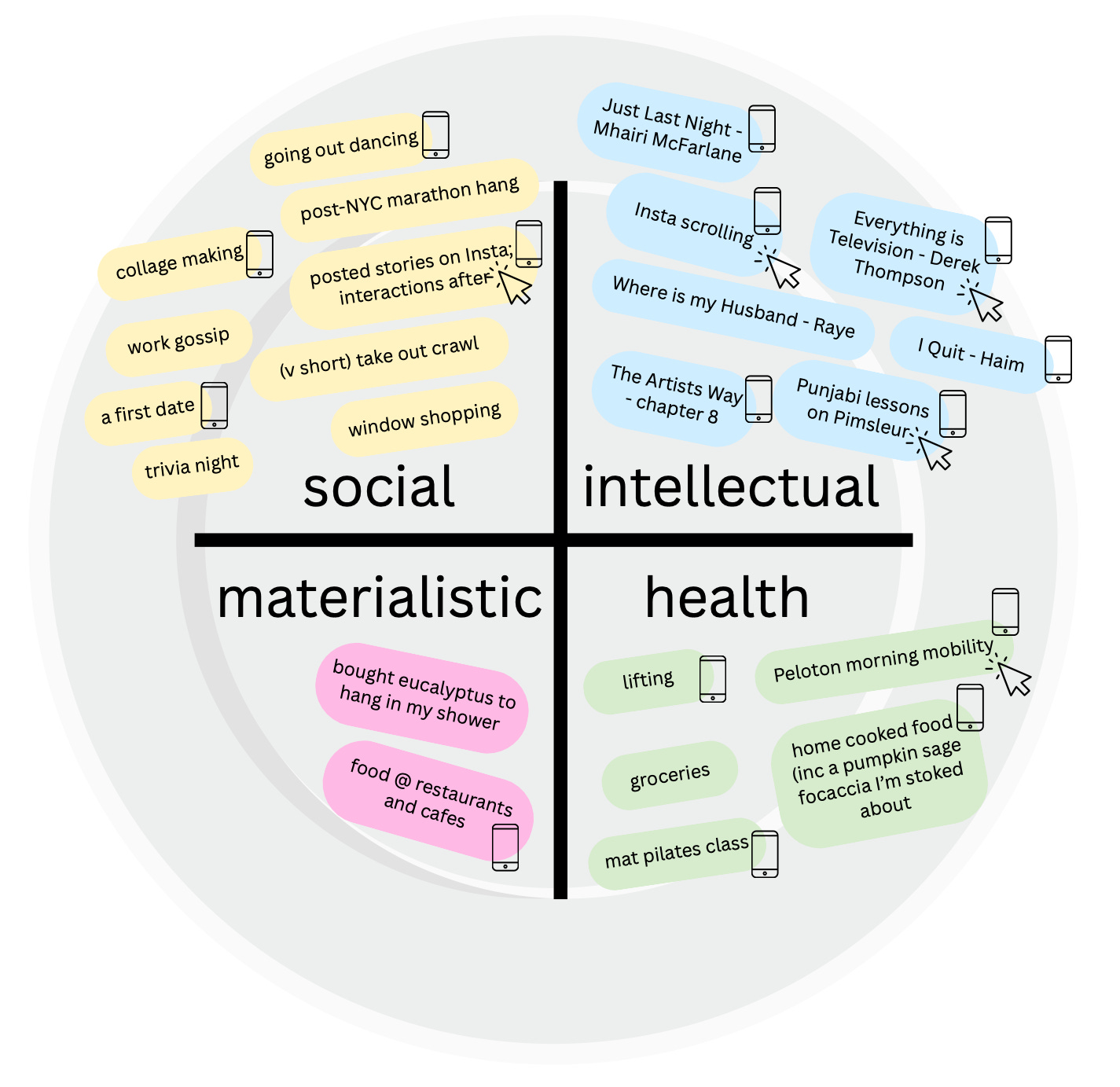
The arrow icon indicates a digital experience, something I engaged with on my phone or laptop. The phone icon indicates digitally-influenced, ex: I looked up places to go out dancing, I read Just Last Night because it was recommended on Downtime, and I learned about Pimsleur on Reddit.
Takeaways:
Visualizing my consumption in this way has made me realize I might be socializing too much, but I’m pretty happy with the materialistic, health, and intellectual buckets. I do feel guilty about scrolling Insta, but maybe I shouldn’t since it’s just a bite on a full plate - I’m still living my life and using my phone for other beneficial things.
There’s a lot of digital content that I didn’t capture here - emails I automatically delete, articles I start and don’t want to finish, recipes I read that I don’t make, reels I scroll through and immediately forget. I’d argue that this peripheral content doesn’t belong on “myPlate” because I can’t fully control the fact that it comes in and I don’t fully engage with it. Is it fair to equate it to kitchen scraps, the potato peels and apple cores you have to sort through to get to the good stuff? Or is it junk food, formulated to release dopamine with no nutritional value?
My time on the Internet has a large influence on every part of my life despite my efforts to reduce my screen time and rebalance my dopamine. This NYT op ed, Your Phone Isn’t a Drug. It’s a Portal to the Otherworld, has got me thinking about how I can move away from fixating on digital addiction and instead take a lighter approach to “navigating cyberspace”. I’m still chewing on this and will deep dive into it another time.
At some point, we have to accept that we will neither quit the internet nor live in a world untouched by it…Adapting begins with seeing the internet for what it actually is — not a drug, nor a set of behaviors, but a place we travel to, with its own geography and custom…The central question of cyberspace has always been one of navigation. How do we move through this world while remaining human? What do we bring back from our travels? What bargains do we strike unknowingly? And how do we step back into the world of bodies when part of us would rather remain online? - Your Phone Isn’t a Drug. It’s a Portal to the Otherworld.